Socio-emotional development, measured at scale.
Insight gives education systems an instrument for what they're already committed to measuring — school by school, district by district, across the whole system.
Five schools, no cost

Dashboard
System-level comparative view
Responses
Participation

85%
Validity

81%
Identified challenges
See More

9
total challenges
Social Emotional Skills
4
Learning Environment
3
Personal Well-Being
2
Main Aspects
Main Strength

Motivation
4.1
Biggest Challenge

Affiliation
1.6
Average by area


3.6
Social
Emotional Skills

2.5
Learning Environment

1.6
Personal Well-Being
Require attention
See More

11
Municipalities require attention
Comparison by municipality

Strengths
Needs
Assessment area
018
030
035
Trend
Emotional regulation
4.3
3.8
3.8
Strength
Self-Management
3.8
4.3
3.0
Strength
Resilience
3.8
3.0
4.3
Strength
Collaboration
4.3
1.9
3.8
Need
Self-efficacy
3.8
3.0
1.9
Need
State progress

Assessment area
2026
2027
2028
Progress
Emotional regulation
3.8
4.4
4.5

0.7
Self-esteem
3.0
3.8
4.9
1.9
Registered support plans
Municipality 1
3
4
3
2
12
Municipality 2
3
4
3
2
12
Municipality 3
3
4
3
2
12
Municipality 4
3
4
3
2
12
Municipality 5
3
4
3
2
12
Universal
By School
By Grade
Individual
Municipalities that require attention

Municipality 3
Lowest social emotional score in the state · Emotional regulation and Self-Management at mid-level
1.9
SEL
12
Schools
at risk
Municipality 1
Social emotional score decreasing · Frustration tolerance lower than average.
2.2
SEL
9
Schools
at risk
Municipality 5
Lowest well-being score in the state · Self-esteem as main construct for improvement.
3.5
SEL
6
Schools
at risk
Challenge
Need
Strength
High Strength


Require attention

11
Municipalities require attention

Indicator 1 of 4
Emotional Regulation
3.7


The ability to recognize, understand, and manage emotions in a healthy and productive way.
Components
Emotional Management

2
Emotional Recognition
Identifying Emotional Triggers

1
Emotional Expression

3
Emotional Management
Preschool
4.3
Elementary
2.3
Middle School
3.7
High School
4.1
Teacher comments
2

?
How easy is it for you to identify and recognize the emotions of your students and colleagues at school?

Anonymous Educator
Middle School
Answer:
Very difficult - I can almost never identify them
What is the reason you think this way?
Students rarely express how they feel, making it hard to read their emotions.
What could you or the school do about it?
Implement regular emotional check-ins at the start of each class.

Anonymous Educator
Elementary
Answer:
Very difficult - I can almost never identify them
What is the reason you think this way?
Young children often show emotions through behavior rather than words.
What could you or the school do about it?
Provide training on recognizing non-verbal emotional cues in students.
Policy alignment · India
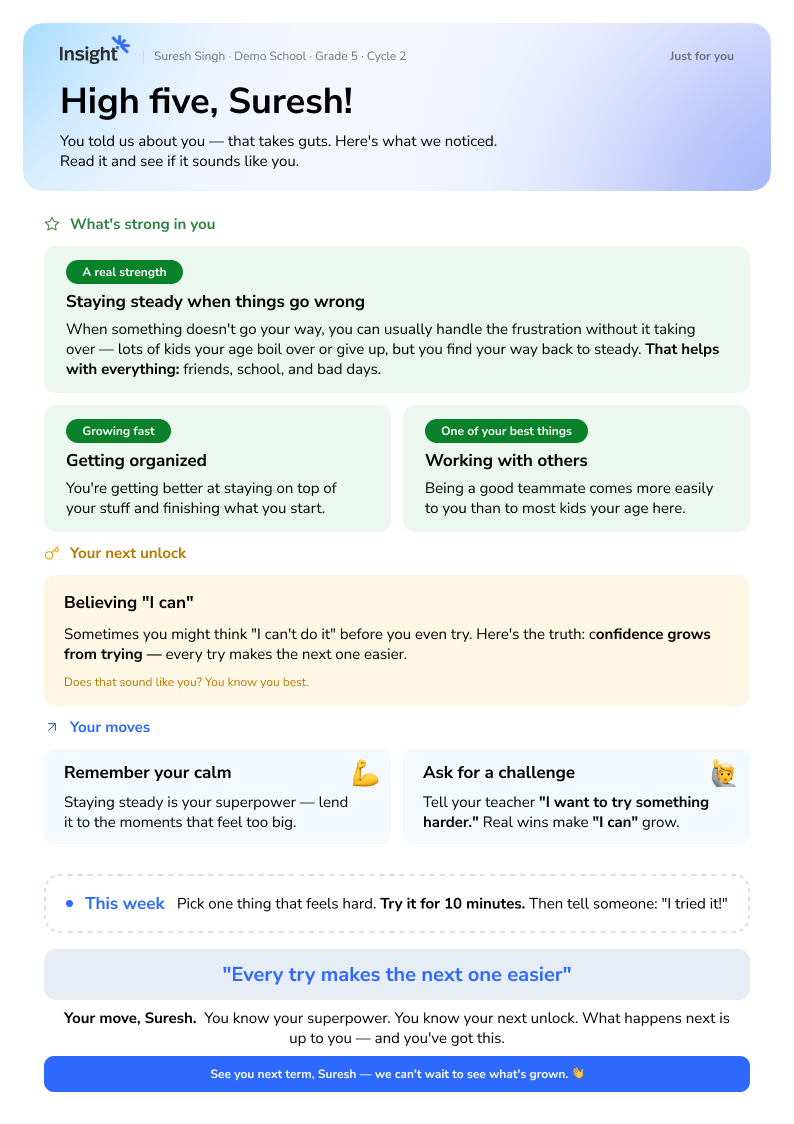
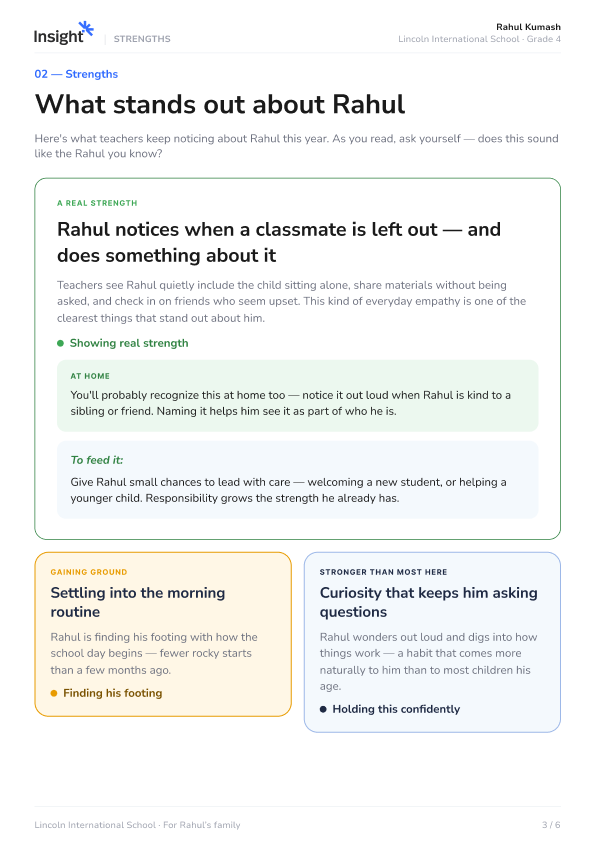
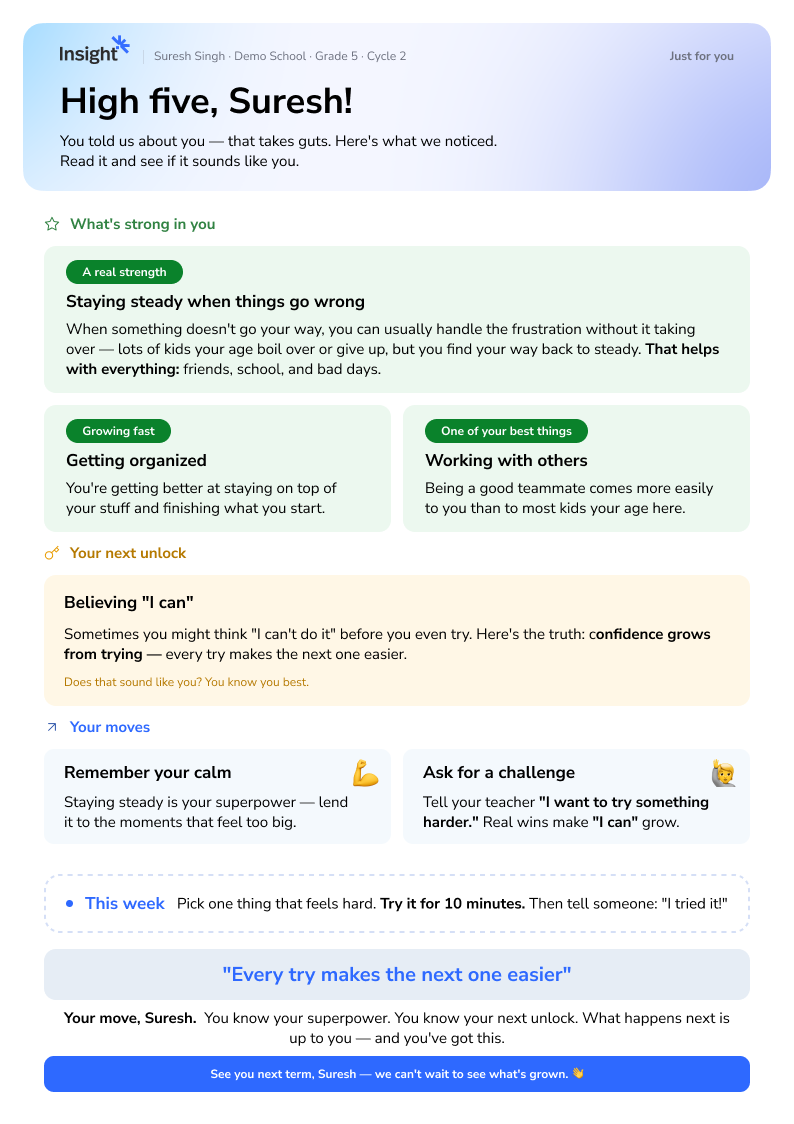
NEP 2020 already mandated the whole child. Insight measures it.
India's National Education Policy requires schools to move beyond marks. Most schools have no instrument to do that yet.
NEP 2020 asks
A 360° view of the child, beyond marks
Insight → Individualized SEL assessment — the child, not the average
NEP 2020 asks
Measured social-emotional development
Insight → SEL as the platform's entire core, not a bolt-on
NEP 2020 asks
Continuous, competency-based assessment
Insight → A running assess → Intervene → Measure → Report loop
Clause by clause.
Select a clause to see what it asks for and what answers it.

Section 4.4
Holistic Development

Section 4.4
Self-Awareness
Holistic Development
The policy asks for
Recognizing each student's unique capabilities, rather than ranking them on marks.
What answers it
Self-Awareness modules
Moves beyond grades to identify what each student is actually capable of.
HA
Hector Acevedo
6° Primaria · 6°B
Skills vs. class average
Motivation
4.1 / 3.4
Affiliation
1.6 / 3.0
Self-esteem
2.8 / 3.1
Affiliation over time
Oct
1.2
Feb
1.4
May
1.6
A student result and the capability profile behind it.







Not a parallel program. A measurement layer.
Most education systems already have priorities they've committed to. What they usually lack is an instrument that tells them whether those commitments are being met, and where.
Insight doesn't replace what you're already doing. It measures it — connecting to the strategy you already have, in the language you already use.

Learning outcomes

Equity

Citizenship

School leadership
Market-specific — these are named in your own framework's language.
From the classroom to public policy.
The same data that helps a teacher help one student becomes evidence at every level above it. Nobody is measured twice, and no school is measured without getting something back.
Student: Hector Acevedo
Assessment
April 2025


Download Report
hector.acevedo@gmail.com
Hector Acevedo
6° Primaria · 6°B
Support level
INTENSIVE
Validated attention

Validated
Progress
Oct
3.7
Feb
3.6
May
3.5
Main aspects
Main Strength

Motivation
4.1
Biggest Challenge
Affiliation
1.6
Identified challenges
See more

3
total challenges
Social Emotional Skills
1
Learning Environment
1
Personal Well-Being
1
Average by area


3.6
Social Emotional Skills

2.5
Learning Environment

1.6
Personal Well-Being
Identified strengths
See more
4
total strengths
Social Emotional Skills
2
Learning Environment
1
Personal Well-Being
1
Strategies for Hector
Overview · Showing individual strategies

✦ New strategy

Maria suggests
Based on 4°A assessment
Emotional control
1.3
Emotional support
1.3
Feeling of fulfillment
2.0
Active strategies
Daily emotional check-in — Hector
✦ Maria
05/20/2026 · By Ana Paula Perez
INTENSIVE · Resilience › Long-term commitment

Weekly current events debate — Hector
Manual
05/20/2026 · By Ana Paula Perez
INTENSIVE · Collaboration › Generating ideas

01
Individual level
Students and school staff. Each person's real needs, identified.













A signal for where to act first.
Every school and region is placed on a clear scale — not to rank them, but to show where support is most urgently needed, and where something is already working well enough to learn from.

Challenge

Need

Strength

High
Equity stops being a stated commitment and becomes something you can locate on a map.
Results by domain
Key indicators
Main Competitive advantage

Motivation
Your school
4.1
Others
3.7
+0.4 pts
vs similar
Biggest competitive challenge
Affiliation
Your school
2.8
Others
3.5
-0.6 pts
vs similar
Vulnerable students
Your school
24%
Others
18%
+ 4.0%
vs similar
See More

Participation in the assessment
Students who complete the assessment
Your school
84%
Others
92%
Students who respond with attention
Your school
91%
Others
88%
Average by domain
Social Emotional Skills
Δ
+0.5 pts
Your school
4.1
Others
3.6
Learning Environment
Δ
-0.4 pts
Your school
3.2
Others
3.6
Personal Well-Being
Δ
-0.3 pts
Your school
3.7
Others
4.0
Social Emotional Skills
P 43
2.9
3.6
Δ -0.7
Collaboration

4.1
4.6
Δ -0.5
Growth mindset

P 61
4.2
4.0
Δ+0.2
Emotional regulation

P 89
P 13
2.1
1.6
Δ +0.5
Social awareness

Assessment areas
Your school
Others
Δ Difference
Position (%)

Your district compared to others

Indicator 1 of 4
Emotional Regulation
3.7


The ability to recognize, understand, and manage emotions in a healthy and productive way.
Components
Emotional Management

2
Emotional Recognition
Identifying Emotional Triggers

1
Emotional Expression
3
Emotional Management
Preschool
4.3
Elementary
2.3
Middle School
3.7
High School
4.1
Teacher comments
2

?
How easy is it for you to identify and recognize the emotions of your students and colleagues at school?

Anonymous Educator
Middle School
Answer:
Very difficult - I can almost never identify them
What is the reason you think this way?
Students rarely express how they feel, making it hard to read their emotions.
What could you or the school do about it?
Implement regular emotional check-ins at the start of each class.
Anonymous Educator
Elementary
Answer:
Very difficult - I can almost never identify them
What is the reason you think this way?
Young children often show emotions through behavior rather than words.
What could you or the school do about it?
Provide training on recognizing non-verbal emotional cues in students.

Teachers and school leaders, measured with the same depth.
Insight assesses the socio-emotional disposition of teachers and directors alongside students. For a system planning professional development at scale, that turns training from a guess into a targeted investment — you know which schools need what, before you spend.
Grounded, validated, and open to inspection.
Insight measures socio-emotional constructs with psychometric rigor — calibrated by age band, tested at scale, and traceable from every finding back to the evidence behind it.

Age-banded and psychometrically calibrated.
Constructs measured appropriately for developmental stage, not applied uniformly across ages.

Root-cause architecture.
Not only what is happening, but why — so intervention is targeted rather than blind.

Independently certified.
ESSA Level 3 evidence standards, and recognized for methodological distinctiveness by the EdLATAM Alliance.

Tested at scale.
Findings drawn from more than 50 million assessments a year, across nine countries — patterns, not single-study claims.
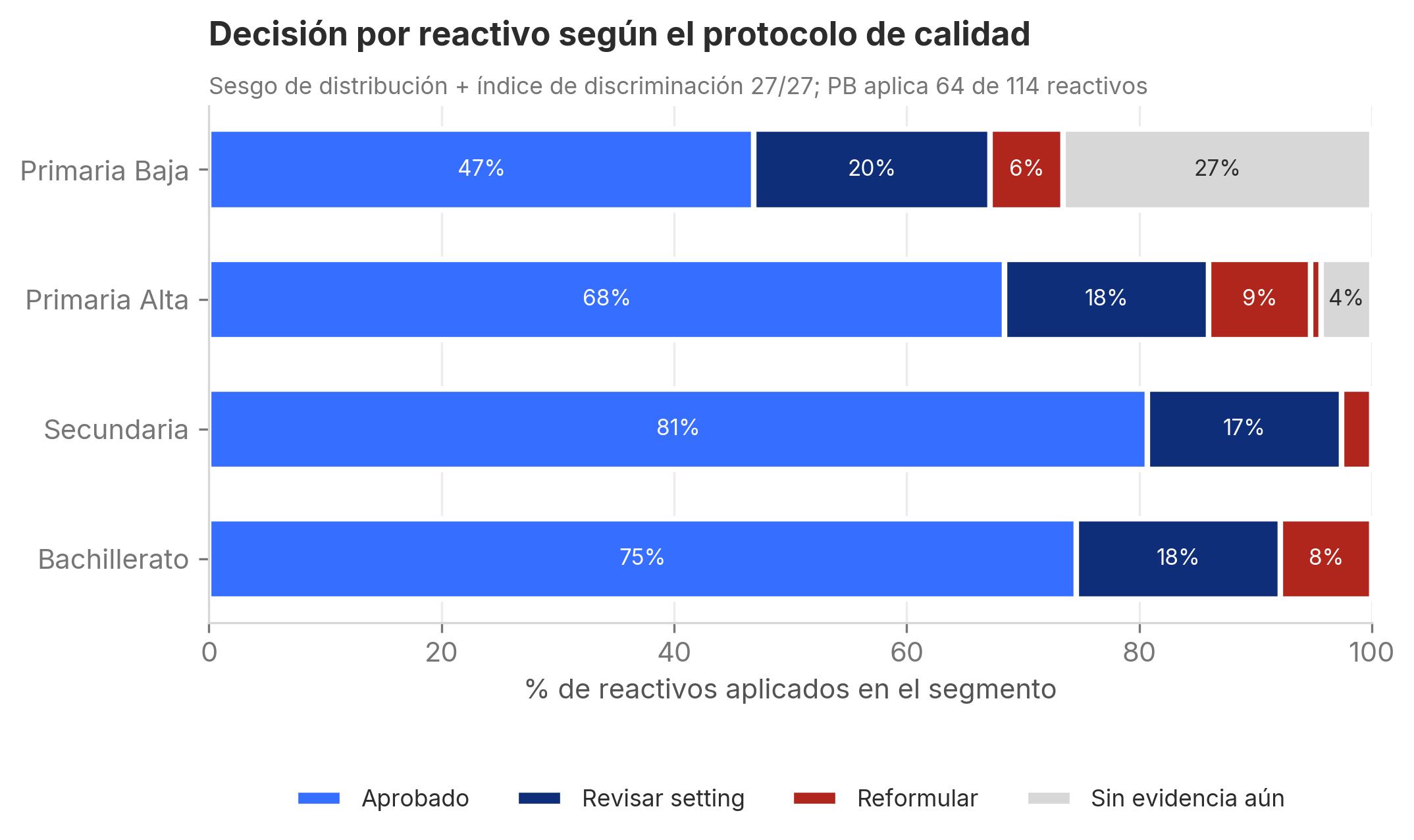
Item decision per quality protocol
Distribution bias + discrimination index 27/27; LE applies 64 of 114 items
% of items applied in the segment
Approved
Review setting
Reformulate
No evidence yet
Lower Elem.
Upper Elem.
Middle School
High School
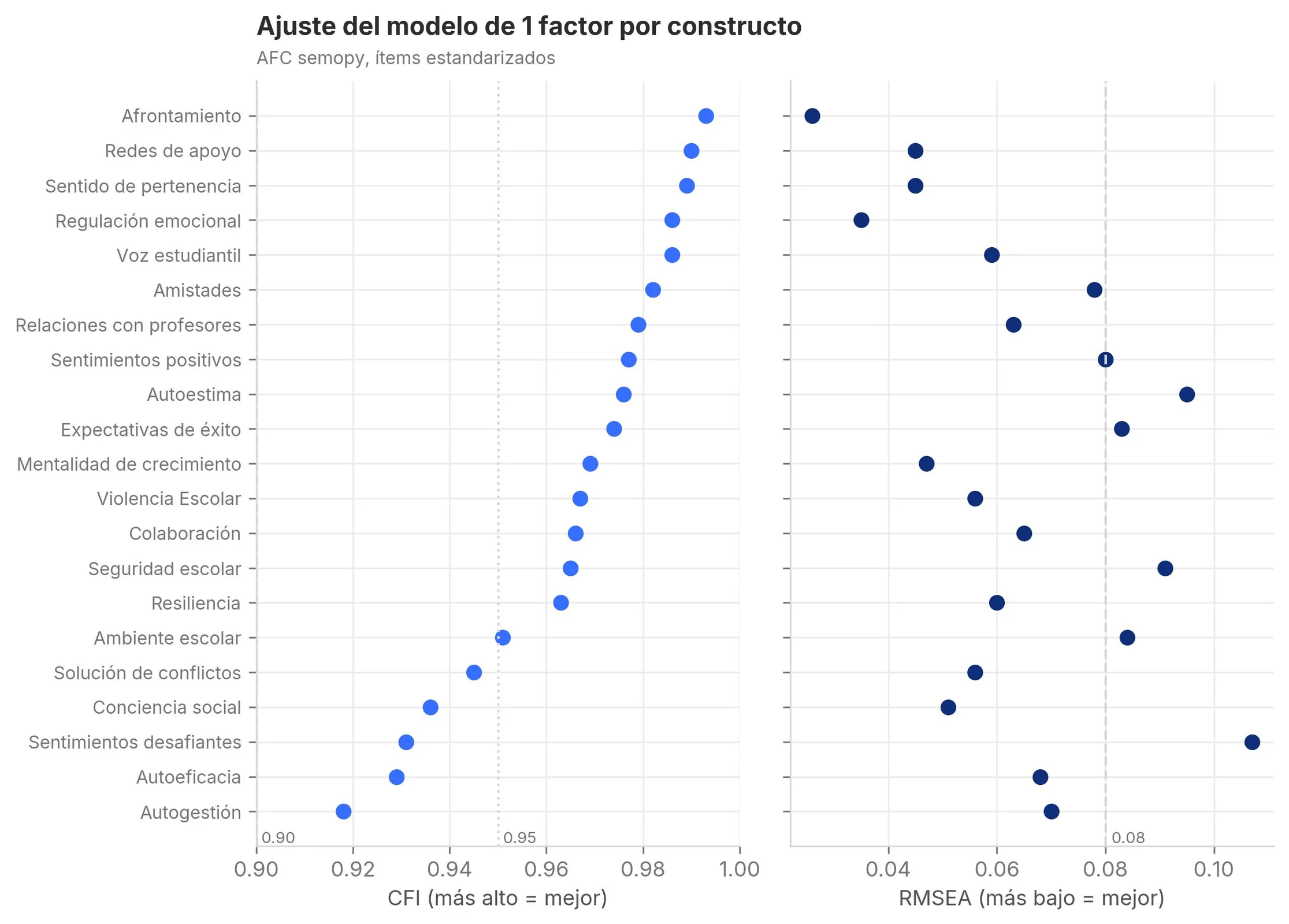
Coping
Supportive Networks
Sense of Belonging
Emotional Regulation
Student Voice
Friendships
Teacher Relationships
Positive Feelings
Self-esteem
Success Expectations
Growth Mindset
School Violence
Collaboration
School Safety
Resilience
School Environment
Conflict Resolution
Social Awareness
Challenging Feelings
Self-efficacy
Self-Management
CFI (higher = better)
RMSEA (lower = better)
1-factor model fit by construct
CFA semopy, standardized items
Children's data, handled accordingly.
Insight holds the 1EdTech TrustEd Apps Data Privacy Certification — an independent review against a rubric built by K-12 districts, universities, and government agencies, covering what data is collected, how it's secured, whether it's shared with third parties, and whether it's used for advertising. It isn't.
Aggregate views never expose individual students. What moves upward through the system is evidence about patterns, not files about children.
Data Privacy Certification
What the data makes visible.
Across schools using Insight, the patterns are consistent enough to inform planning:
Beyond aggregate outcomes, the assessments surface findings that change how systems plan — for instance, that students who disengage before graduation almost always show low sense of belonging first, and that the settings where belonging is built are identifiable and addressable.
+13%
average academic improvement
−17%
average reduction in dropout
100%
client retention since launch
Built by people who've worked inside education systems.

Dr. Salvador Cerón
Partner and Research Advisor
Drove nationwide educational transformation in Mexico, using data and evidence to shape public policy.

Fernando Valenzuela
Director of Product Strategy
30+ years in digital learning. Led transformation for major publishers across the Americas.

Alan Greenberg
Director of Education & Innovation
Former Director of Apple Education for Asia, with deep product design expertise.
Certified and recognized.
Recognized by EdLATAM Alliance for the distinctiveness of the methodology.
Certified Data Privacy, independently audited.


MODERATED IMPACT
Third Party
Validation
2026
ESSA Level 3 evidence standards.



Start with five schools.
Before any commitment, run Insight in five schools from your district or network — at no cost.
You see what the instrument surfaces in your own system, and decide from there.

5 schools
from your district or network

50 students per school
assessed at no cost

Full results
plus access to the platform